SS44.ca: Building a Resume as Code
- tags
- #Hugo #Typst #CI/CD #Web Development
- categories
- Portfolio Engineering
- published
- reading time
- 3 minutes
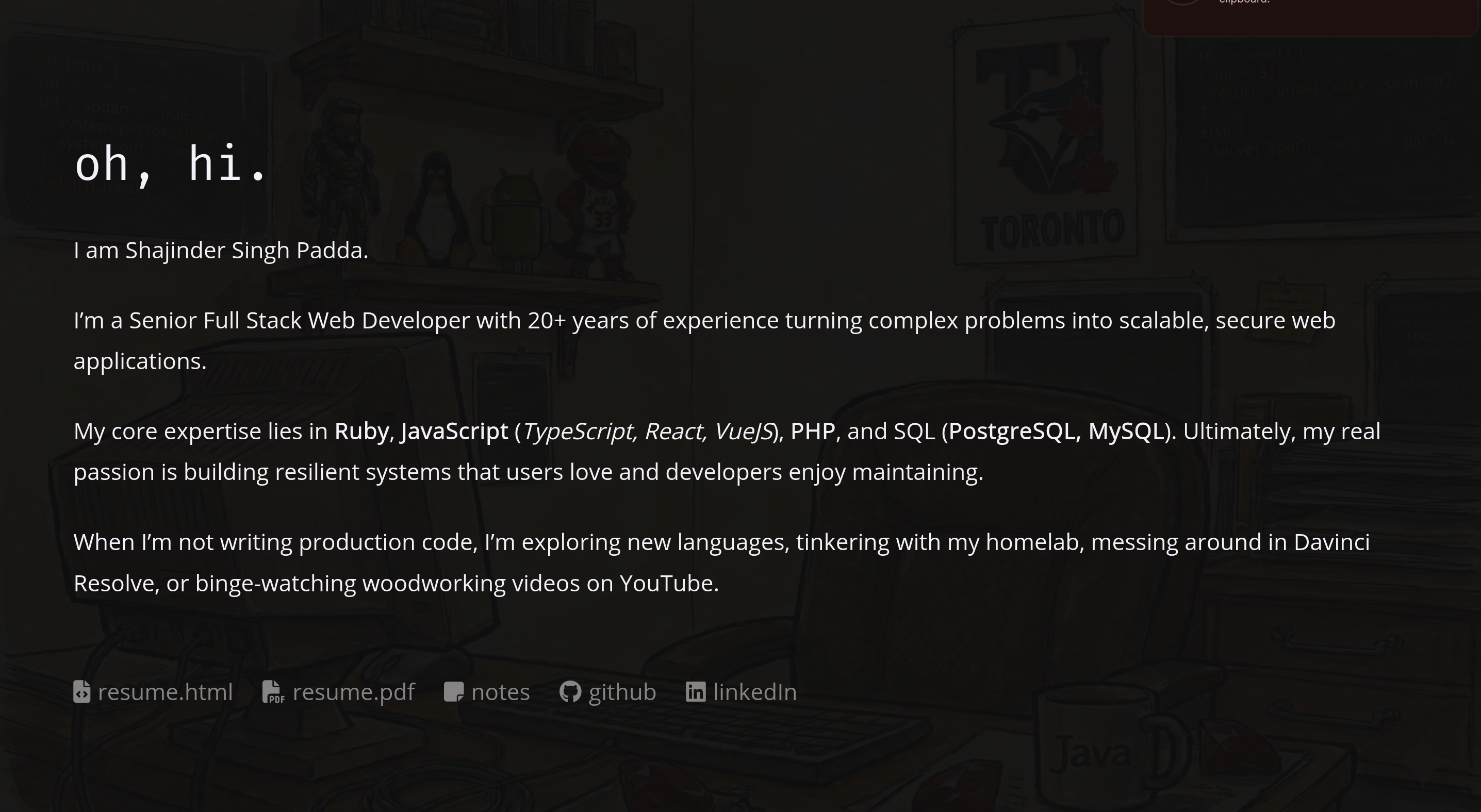
ss44.ca is my professional landing page and digital garden. It’s a place to host my resume, document my homelab, and highlight some technical projects to advertise my skills.
The Motivation
I don’t even know if professional personal websites are still a primary requirement, or if they are a relic of a bygone era. However, I vividly remember career counselors emphasizing: “at least be able to prove you can do some of what you say you can, by having a domain with some of what you say you do on it.”
It’s been a while since I’ve been actively in the job market, and whatever site I had prior has long been lost to the abyss of time, stranded on some forgotten self-hosted Git server. So I thought I’d spin up a new one—because why not?
I won’t pretend to have a plethora of massive open-source contributions I can proudly stick on this proverbial magnetic fridge. Since most of my professional work is hidden away behind proprietary code and NDAs, the least I could do is put my architecture skills on display while creating a foundation to post future technical notes.
At the very least, it proves I’m not just an agentic AI bot spamming resume sites. As the saying goes: I exist, because I have a domain name that says I do.
Architecture & Tech Stack
So what do we have here? “A WordPress site? With some fancy plugins?” NOPE.
- Core Data: Markdown and YAML. I was big on plain text files before AI made them cool again, and I refuse to let them steal my shine.
- Static Site Generator (SSG): Hugo . While I’ve used Jekyll heavily in the past, Hugo’s Go-based architecture offers significantly better build times and superior asset management (like Page Bundles).
- Document Generation: Typst . Where has this been hiding my whole career? Long gone are the days of hacking HTML-to-PDF converters or managing heavy Puppeteer dependencies just to render a document.
- Migration Engine: Custom Python scripts to automatically ingest old legacy Jekyll posts, parse Frontmatter, dynamically resize images, and rewrite paths to fit the modern Hugo ecosystem.
Development Process & Challenges
The real engineering sauce here isn’t just that it’s a static site generator. The true value is treating my Resume as Code.
Both the resume.html page and the resume.pdf download are generated dynamically from the exact same underlying resume.yml data file.
When explained like that, it might sound simple, but having my resume exist purely as structured text data within a Git repo—which automatically generates an updated, perfectly styled PDF via a CI/CD pipeline on every deploy—is a massive upgrade. It completely beats my old Google Docs workflow.
What’s Next
- Consistency: Try to publish technical posts here semi-regularly to justify keeping the domain around.
- Expansion: It was a fun distraction building this, and I leaned on AI tools to help write the migration scripts and clean up the CSS. I plan to document those AI integration workflows in future posts.
Note: The home page slide layout and aesthetics were heavily inspired by mnjul.net .