What Happened To Pinterest?!
- tags
- #AI #Social Media #Enshittification
- categories
- Opinion Engineering
- published
- reading time
- 3 minutes
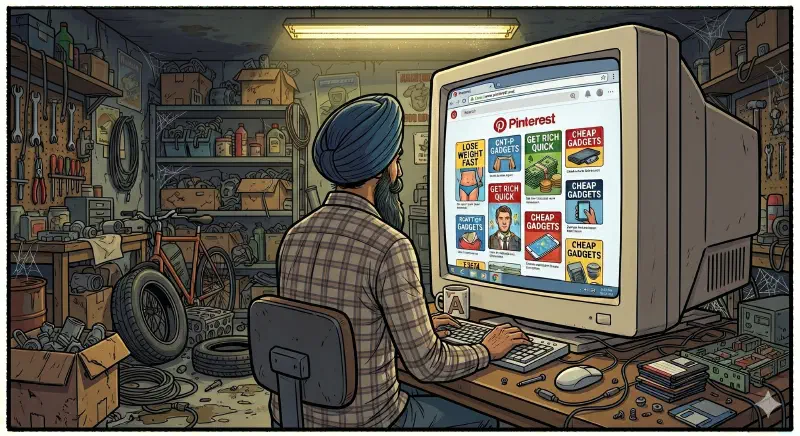
What happened to Pinterest?
There was a time when the site was genuinely unique. If you had an idea, needed inspiration for a project, or wanted to curate a mood board, it was the go-to site. Aside from digging through niche subreddits, there was simply no other space like it. The core value proposition was simple and effective: empowering users to curate ideas, links, and images into structured, personal collections.
I’m looking to convert my garage into a home office in the coming months. I need the space and well our new place doesn’t come with any extra rooms for me to hijack. Since I’m starting anew, I figured maybe there’s some inspiration out there for me to see what this space could look like. So I do what you’re supposed to do or at least what I was used to doing. I open up Pinterest I typed “garage home office inspiration” and well here we are.
If you scroll through a feed now, the breakdown is, well bleak: 50% of the screen is ads, 35% is nonsensical AI slop, and the remaining 15%? Well that just points to random blog links that are… you guessed it, just more AI prompts dedicated to helping fill a soulless void.
Is this really the utopian future AI was supposed to provide? Or is this just the result of an overzealous VP’s grand idea on how to endlessly curate and generate content without actually needing to rely on human curators?
I’ve already taken a photo of my space and asked Gemini for some ideas. The imagen chat-bots already exist and are an easy prompt away from drawing up some fantastical home office rendering. I’m not looking for Pinterest to do that for me. Those sites are already doing that and they do it pretty well.
It’s not an isolated incident. We’re seeing Instagram toying with the same idea. Curating content without needing creators, experimenting with AI influencers to drive engagement.
But if you remove the humans generating the content, who is left using the site? Real people quickly realize the platform has become unusable or useful. When the signal-to-noise ratio drops to zero, the user base evaporates.
From an engineering and business perspective, this is a fatal spiral. The compute token costs will only increase as the platform becomes more reliant on AI to fill its empty feeds forcing more ads to keep the lights on. Simultaneously, as the platform becomes a ghost town of synthetic media, user traffic is guaranteed to trend nowhere but down.
So who does this Frankenstein future actually serve?
The old Silicon Valley adage goes, “If the service is free, you’re the product.” But when the people using the service are slowly pushed away by an avalanche of synthetic garbage, what exactly remains to be monetized? You end up with a closed loop of bots serving ads to other bots.
Pinterest isn’t a casualty of AI. It’s a casualty of forgetting its core utility and failing to put its users first.
This article was originally published on LinkedIn. Join the conversation there!